Dopamine, Discipline and Performance: What Every Athlete Needs to Know After Winning
2/17/20264 min read
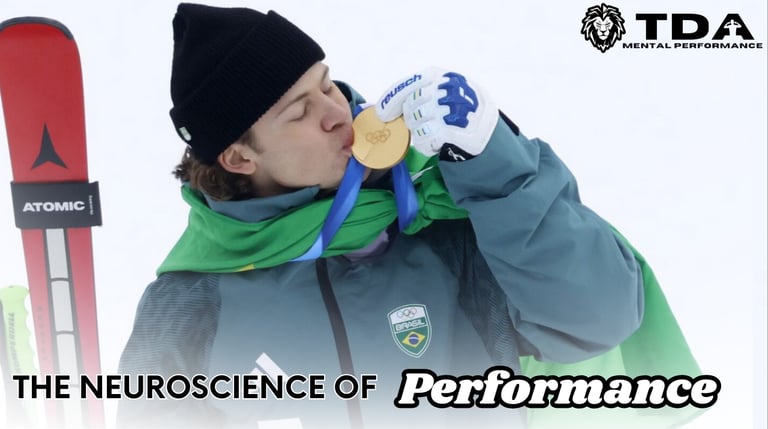

When an athlete achieves a major victory, the impact goes far beyond the physical, technical, or emotional level. There is a profound neurobiological shift that takes place in the brain and nervous system. These changes are natural, deeply rooted in human biology, and they directly influence attention, motivation, emotional regulation, and execution in subsequent competitions.
Lucas Pinheiro Braathen made history by winning Brazil’s first-ever gold medal in the Winter Olympics. This was an extraordinary achievement, not only personally, but for an entire country. Moments like these represent the highest level of competitive success — the culmination of years of discipline, sacrifice, and intentional execution.
However, from a neuroscience and psychological standpoint, moments like these also trigger powerful neurochemical shifts that must be understood and managed.
A few days later, Lucas competed again in the slalom event and unfortunately fell, ending his chances of another medal. It is important to acknowledge that external conditions played a major role. There was a snowstorm, visibility was extremely poor, and more than half of the competitors were unable to finish the course.
Lucas himself said:
“Visibility is difficult. You don't have the help of visibility to read the texture and terrain of the snow, and so you need to connect with your heart and ski intuitively. (…) when I got to that part, I was trying to push and create all the speed and I left the discipline at home, I wasn't focused on technique, I was just skiing with intensity.”
This statement reveals something extremely important from a neuroscience and performance psychology perspective.
He did not blame external factors. He recognized a shift in attentional discipline.
This is where neuroscience helps us understand what truly happens after major victories.
When an athlete wins, there is a massive release of dopamine.
Dopamine is not simply the “pleasure chemical.” It is the neurochemical responsible for motivation, pursuit, anticipation, and goal-directed behavior. Dopamine drives effort. It creates hunger. It pushes the athlete forward.
When an athlete achieves a major victory, dopamine spikes significantly above baseline.
This spike creates a powerful feeling of reward, satisfaction, and reinforcement. The brain encodes the experience as highly meaningful and successful.
However, the brain operates through a principle called homeostasis — the constant effort to maintain internal balance.
After a large dopamine spike, the brain compensates.
This compensation leads to what is known as a dopamine baseline drop, often referred to as a dopamine crash.
This does not mean dopamine disappears. It means the baseline level temporarily drops below its previous normal level as the brain recalibrates.
This has very important implications for performance.
When dopamine baseline is temporarily reduced, the athlete may experience subtle changes such as:
Reduced urgency
Reduced hunger to pursue
Reduced attentional sharpness
Reduced drive to execute with the same intensity
This happens even if the athlete consciously wants to perform at their best.
This is not a mindset issue. It is neurobiology.
Additionally, dopamine receptors also undergo temporary desensitization after major reward events. This means that the same behaviors that previously generated strong motivational drive now generate a slightly weaker signal.
This is why many athletes unconsciously experience a dip in performance consistency after major wins.
The brain has temporarily shifted from a pursuit state to a reward recovery state.
At the same time, serotonin levels increase following victory. Serotonin is associated with feelings of satisfaction, status, and emotional stability. From an evolutionary standpoint, elevated serotonin signals to the nervous system that the individual has successfully achieved a dominant position.
While this improves emotional well-being, it also reduces the urgency signal associated with pursuit.
Noradrenaline, which regulates alertness, reaction speed, and attentional precision, may also fluctuate. Noradrenaline is essential for maintaining sharp attentional control in high-speed environments.
Even small fluctuations can influence micro-decisions, timing, and execution precision.
From a brain structure standpoint, the prefrontal cortex plays a critical role.
The prefrontal cortex is responsible for executive control — discipline, focus, emotional regulation, and adherence to strategy. It ensures that execution follows trained patterns rather than emotional impulses.
When dopamine and emotional systems fluctuate, there can be temporary interference in prefrontal cortex efficiency.
This leads to execution driven by intensity rather than discipline.
This aligns perfectly with Lucas’s own words when he said he was skiing with intensity rather than technique.
Intensity without precision reduces performance reliability.
This is where Cognitive Behavioral Therapy (CBT) principles also play a critical role.
CBT explains that thoughts influence emotions, emotions influence physiology, and physiology influences behavior.
After major victories, subtle cognitive shifts often occur unconsciously. These may include thoughts such as:
“I already proved myself.”
“I can push harder.”
“I can rely more on instinct.”
These are not signs of weakness or arrogance. They are natural cognitive adaptations following reward.
However, elite performance depends on behavioral consistency, not emotional state.
The greatest athletes in the world do not rely on emotional intensity to perform. They rely on systems that stabilize execution regardless of emotional state.
This is trainable.
Through mental training rooted in neuroscience and behavioral psychology, athletes can stabilize dopamine baseline faster, maintain prefrontal cortex engagement, and preserve attentional discipline.
There are several practical tools athletes can use.
The first is rapid cognitive reset.
After every competition, the brain must be redirected toward the next objective. This prevents prolonged dopamine reward state and restores pursuit mode.
The second is maintaining strict behavioral consistency.
The brain stabilizes faster when routines remain identical regardless of previous results. This reinforces neural efficiency and attentional patterns.
The third is controlled exposure to new goals.
Setting new targets immediately after major victories helps restore dopaminergic motivation circuits and re-engage pursuit neurochemistry.
The fourth is attentional training through visualization.
Visualization activates the same neural pathways used during real performance and strengthens prefrontal cortex control over motor execution.
The fifth is nervous system regulation through breathing protocols.
Controlled breathing stabilizes autonomic nervous system balance and improves executive function stability.
The sixth is identity stabilization.
Dominant athletes do not attach their identity to outcomes. They attach their identity to execution standards.
Winning is an event.
Dominance is a regulated neurological and behavioral pattern.
The athletes who remain at the top are not those who avoid dopamine spikes and crashes — because those are unavoidable — but those who understand how to regulate their brain and nervous system through structured mental training.
This is neuroscience.
This is cognitive behavioral regulation.
And this is one of the key differences between athletes who win once and athletes who dominate consistently.